Addiction Statistics in
Orange County, California
Addiction has long been a concern in the United States. But no county is immune to the rising rates of alcohol and drug-related overdoses that result in hospitalizations, emergency department visits, and, unfortunately, deaths.
That being said, different regions of the country are affected by addiction in different ways. Orange County, for example, is located in Southern California, a region notorious for methamphetamine trafficking.1
County-specific data helps you understand the extent of addiction in the region where you are located. Therefore, on this page, you will find the key addiction statistics coming from the official sources of Orange County.
However, we understand that every statistic discussed on this page represents real people. Many of the difficulties they and their families face during their addiction and treatment journey never make it to the headlines.
If you, or any of your loved ones, are dealing with substance misuse and want to get out of the vicious cycle it traps you in, you’ve come to the right place. A Better Life Recovery is a specialized addiction treatment center in Orange County that has 24/7 crisis support and experienced addiction specialists to help you at all times.

Overdose Deaths in Orange County
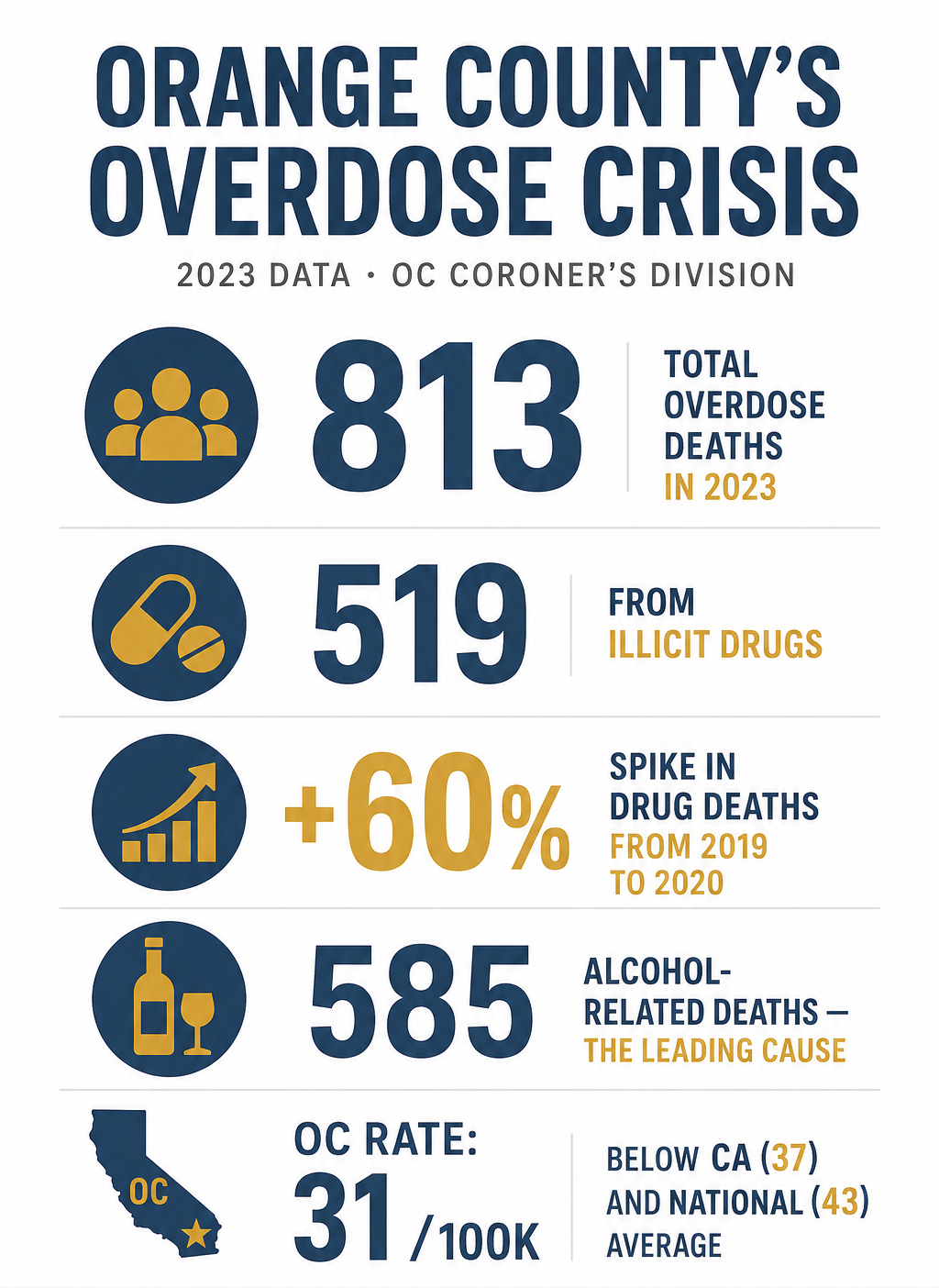
The Orange County Coroner’s Division annual report for 2023, which is the latest data available, reported a total of 813 accidental drug overdose deaths in 2023. Out of these, 519 deaths resulted from illicit drug abuse, and 35 were prescription drug overdoses. Another 158 people died due to a combined overdose of an illicit drug with either a prescription drug or an over-the-counter drug. 16 of the 813 individuals overdosed on ethanol found in beer, wine, and spirits.2
Besides accidental drug overdoses, the Coroner’s Division report also includes data for 55 total suicidal drug overdose deaths in 2023. Out of these, ten deaths were due to illicit drug abuse, 36 deaths occurred due to prescription drug overdose, and the rest from a combination of the two.
Further, Orange County Health Care reports an increasing trend of deaths by alcohol and drugs between 2009 and 2020. The average age-adjusted mortality rate per 100,000 people attributed to drugs and alcohol in Orange County was 20 in 2009. It went up to 31 by 2020.3
Alcohol-related deaths have remained relatively stable over the years. However, deaths by drugs increased from 11 per 100,000 in 2009 to 21 per 100,000 people in 2020. In fact, drug-related deaths in Orange County increased by 60% from 2019 to 2020.
Despite an increasing trend, the age-adjusted mortality rate in Orange County (31 per 100,000 individuals) was lower than that of the national average (43 per 100,000 people) and the California state average (37 per 100,000) as of 2020.
The 2020 mortality data broken down by the type of substance overdosed on is as follows:
- Alcohol: 585 deaths
- Opioids/opiates, including fentanyl: 501 deaths
- Stimulants: 293 deaths
- Sedatives: 193 deaths
- Cocaine: 77 deaths
- Cannabis: 54 deaths
- Other drugs: 32 deaths
The Opioid Crisis in Orange County
In addition to the statistics discussed above, prescription opioid overdose has been of particular concern in recent years. The Orange County Health Care agency’s report from 2022 notes an increasing trend in deaths due to opioids in orange county. The total number of deaths from opioids, including fentanyl, was reported to be 284 in 2016, but this number increased to 501 by 2020. There was also a 45% increase in the number of deaths occurring from opioid overdose from 2019 to 2020.3
In general, the rates of emergency department (ED) visits due to drug-related diagnoses have decreased since 2017, but opioid-related ED visits increased by 22% from 2019 to 2020.
Opioid-related hospitalizations have also been higher than for any other sedative or stimulant drug. The rate of opioid-related hospitalizations for every 100,000 individuals in Orange County increased from 24 in 2009 to 40 in 2020.
However, the use of illicit opioids, not including fentanyl, has been on a declining trend. The Coroner Division report from 2023 finds a 44% decrease in heroin-related deaths over five years from 2019 to 2023. The total number of deaths due to heroin in 2019 was 98, which decreased to 77 deaths in 2020, 40 deaths in 2021, 18 deaths in 2022, and ten deaths in 2023.2
Deaths due to fentanyl, in contrast, have been increasing at an alarming rate. The number of deaths due to fentanyl and its analogs was 147 in 2019. During the pandemic, they increased to 432 in 2020 and 717 in 2021. There has been a slight decrease in the number in 2022 (675 deaths) and in 2023 (613 deaths). Yet the number remains very high compared to what it was five years ago.
Alcohol Use and Alcohol-Related Deaths
Alcohol-related deaths consistently occur among people in Orange County. Besides overdose deaths, many people lose their lives due to fatal crashes resulting from driving under the influence (DUI).
The age-adjusted death rate per 100,000 people in Orange County due to alcohol has remained quite stable since 2009. The Orange County Health Care agency reported the death rate in 2009 to be nine per 100,000 people and ten per 100,000 in 2020.3
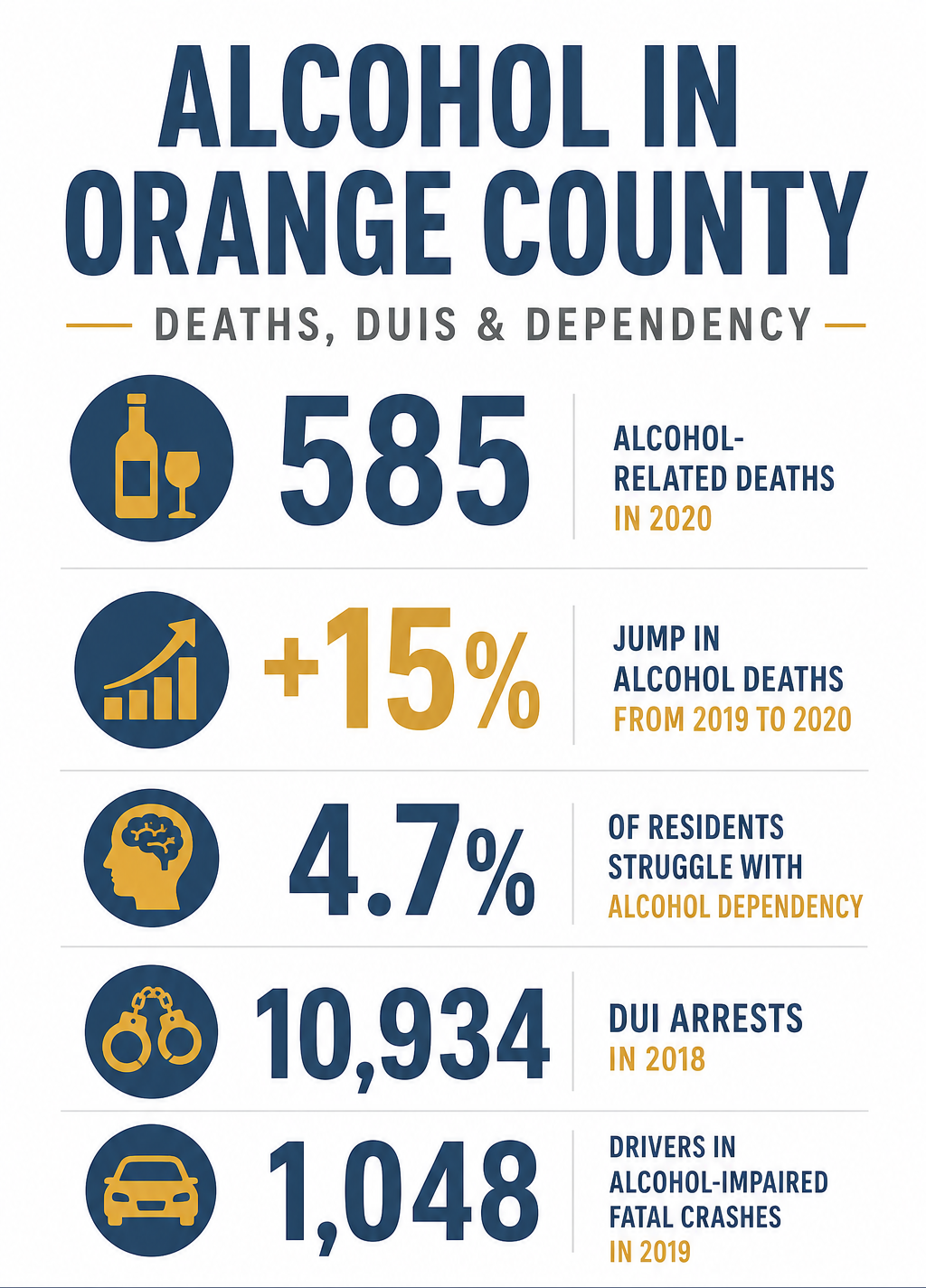
The absolute numbers for alcohol-related deaths had a slight increasing trend in Orange County from 2016 to 2020. And the year 2019-2020 saw a 15% jump in alcohol-related deaths. We break these numbers down further below:
- 2016: 451 deaths
- 2017: 461 deaths
- 2018: 464 deaths
- 2019: 498 deaths
- 2020: 585 deaths
Data from the National Survey on Drug Use and Health for Orange County (California region 14) reported a 4.7% prevalence of alcohol dependency and misuse in 2016–2018 among the people surveyed.4
Additionally, the Annual Report of the California DUI Management Information System reported a DUI rate of 0.3 for every 100 licensed drivers in Orange County. The total number of DUI arrests in Orange County was 10,934 in 2018. This number slightly increased to 11,107 in 2019, followed by a 29% decline to 7,885 arrests in 2020. A total of 1048 drivers in Orange County were also involved in alcohol-impaired fatal injuries and crashes in 2019.5
Methamphetamine in Orange County
The 2023 Coroner Division Annual Report also reported the number of deaths in which methamphetamine was found in the toxicology reports. Meth-related deaths increased quite considerably from 2019 (294 deaths) to 2021 (704 deaths).
Post-pandemic, however, the number of meth-related deaths has been declining. 676 deaths in which methamphetamine was found in toxicology were reported in 2022. This number decreased by 30% to 473 deaths in 2023.2
Stimulant use, including that of methamphetamine, has been the second most common cause of emergency department visits in Orange County since 2012, the first being opioids. In 2018, ED visits due to stimulants even surpassed opioids at a rate of 54 per 100,000 individuals.3
The rate of hospitalizations due to stimulant use has also increased from 2009 (four per 100,000 individuals) to 2020 (eight per 100,000 individuals).
Orange County is part of Southern California, a region known for the highest methamphetamine production, trafficking, and abuse rates in the state.1 The California Department of Public Health ranked Orange County 39th out of the 59 total counties in California for amphetamine-related overdose deaths in 2017. During this time, it had an overdose rate of 3.82 per 100,000.6
The Treatment Gap
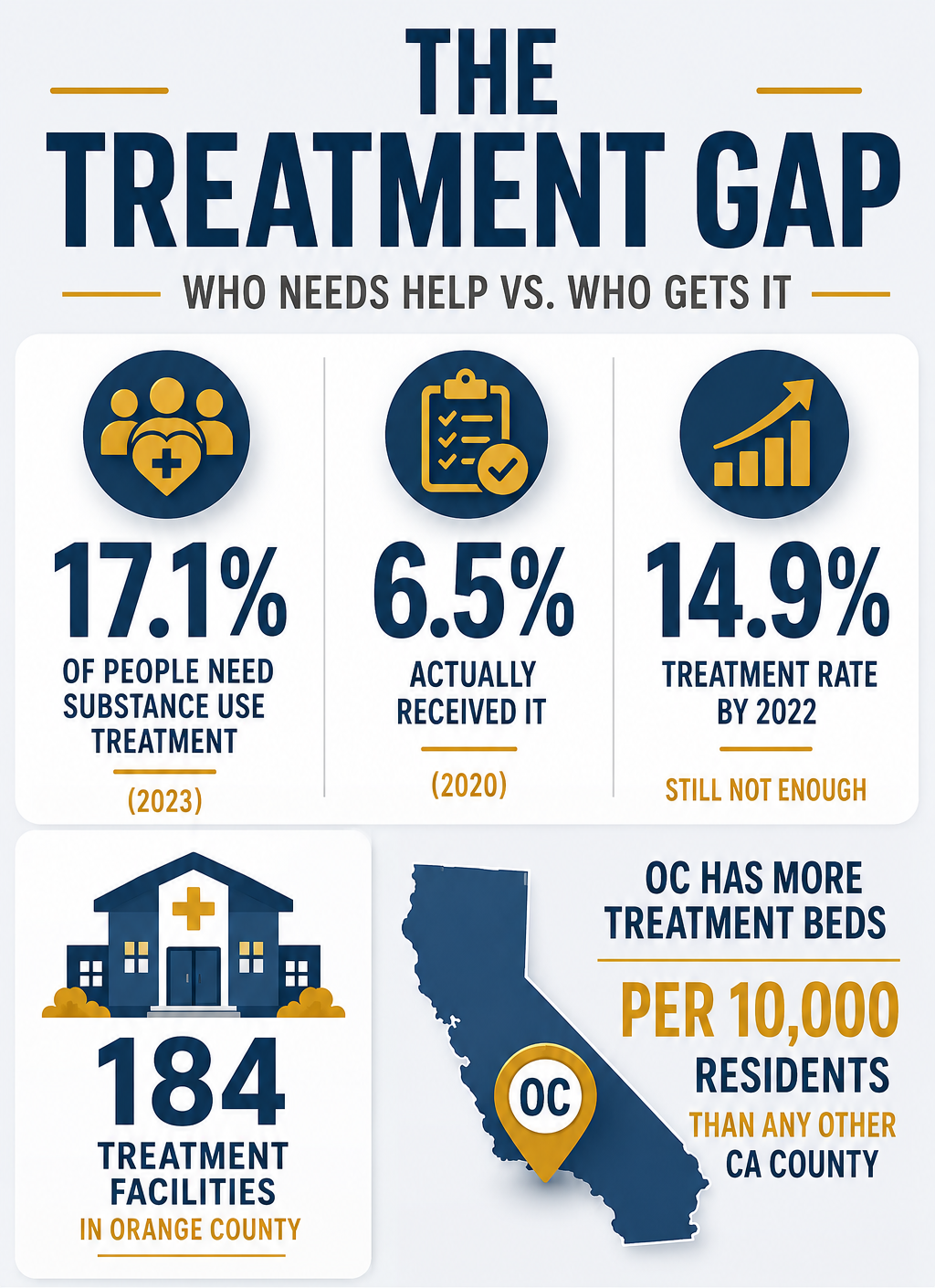
According to a national survey of over six million U.S. citizens, the prevalence of people who need substance use disorder treatment has increased from 8.2% in 2013 to 17.1% in 2023.7
Despite a two-fold increase, the percentage of people who actually received treatment decreased from 9.3% in 2013 to 6.5% in 2020. From 2022 onwards, the treatment rates have increased to 14.9%, but there’s still a gap in the number of people who need treatment vs. those who actually get it.
There are many reasons for this gap. For example, high treatment costs with insufficient insurance coverage, stigma around addiction that kills the motivation for change, poor access to treatment facilities, and so on.
Orange County, fortunately, has a good number of available treatment facilities compared to the rest of California. An estimated 184 substance use disorder treatment facilities are present in Orange County, California. And the number goes even higher if we consider the facilities located within a 25-mile radius of major cities in the county.8
Additionally, the 2023 Drug and Alcohol Treatment Facilities from the California State Auditor mentions that there’s a high availability in the number of beds for small treatment facilities. In fact, the rate for every 10,000 residents is higher in Orange County than in other counties in California.9
If you are dealing with addiction or you know someone who could benefit from professional help for their substance misuse, contact A Better Life Recovery today.
Who Is Affected?
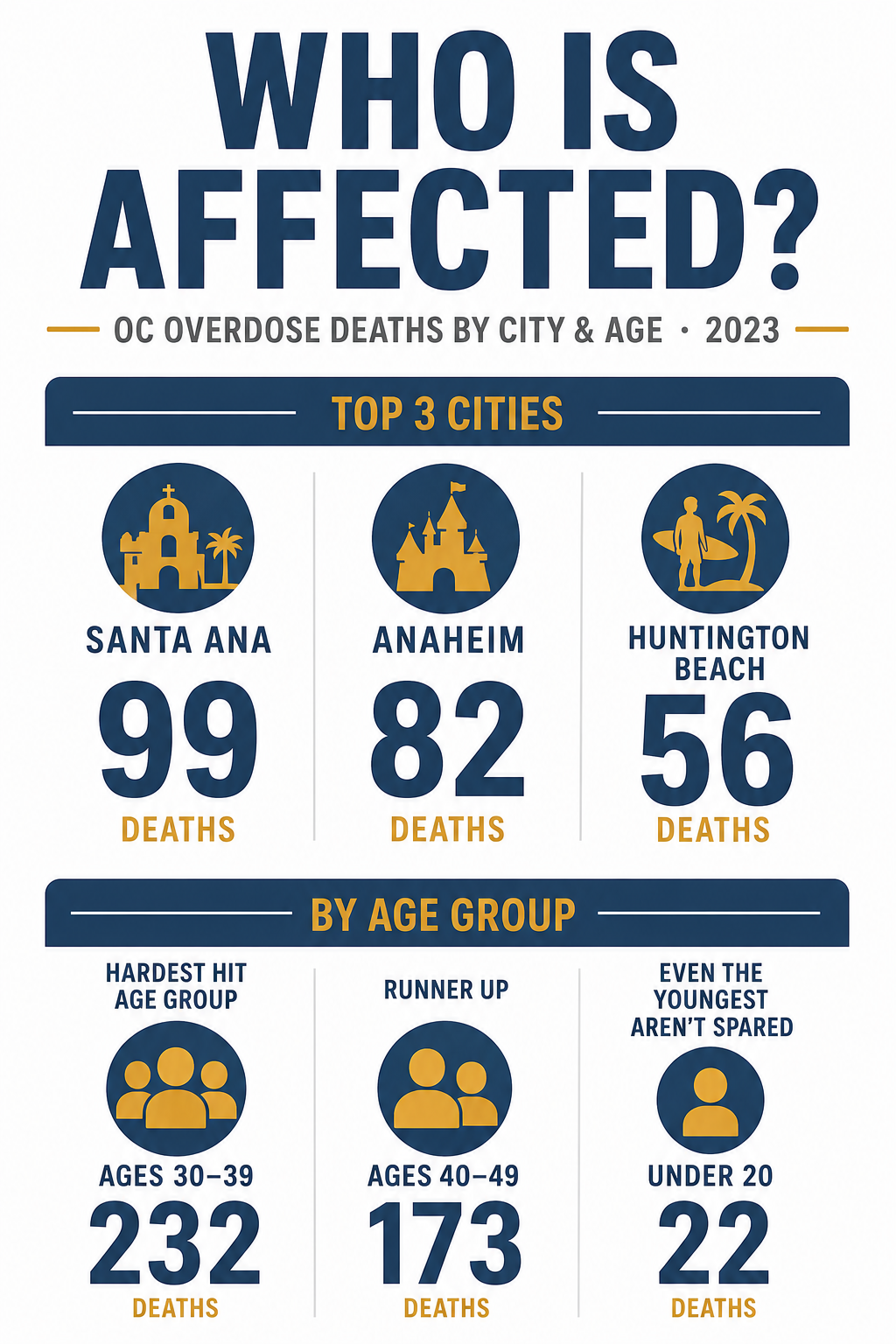
The 2023 Coroner Division annual report lists the top ten cities within Orange County where drug overdose deaths were the highest. These are:
- Santa Ana: 99 deaths
- Anaheim: 82 deaths
- Huntington Beach: 56 deaths
- Garden Grove: 52 deaths
- Fullerton: 37 deaths
- Costa Mesa: 32 deaths
- Westminster: 25 deaths
- Irvine: 22 deaths
- Orange: 18 deaths
- Mission Viejo: 15 deaths
Addiction affects people of all ages; however, drug-related deaths occur most frequently in middle-aged individuals.
When broken down by age groups, people aged 30-39 years had the highest death rate – 232 alcohol and drug-related deaths in 2023. This group was followed by 173 deaths among those aged 40-49. After this, there were 155 deaths in the age group of 50-59 years, 131 deaths in the 20-29 years age group, and 116 deaths in the 60-69 years age group. 22 deaths due to alcohol and drug overdose also occurred in young individuals under 20 years of age. The elderly population aged 70+ had a cumulative 27 drug overdose deaths in 2023.
Mental Health and Co-Occurring Disorders
The 2024 National Survey on Drug Use and Health results documented that 21.2 million adults in the United States had a co-occurring mental illness along with a substance use disorder.10
In California, that makes about 2.17 million people aged 12 and older. Among these, 640,000 individuals have a serious mental illness alongside a substance use issue.
Orange County is no exception to the mental health crisis in the country. The Orange County Community Health Improvement Plan for 2024–2026 mentions that 14.6% of adults in the county had serious psychological distress in the past year.11
The link between mental health and substance use is well-established by science. It’s a two-way relationship, where addiction increases your chances of acquiring a mental illness, and having a mental illness increases your propensity to reach for substances. This is known as “dual diagnosis.”
What These Statistics Mean
Every statistic mentioned on this page is a story of an actual person affected by addiction in the worst possible ways. And the effects of addiction can ripple outwards to those around the person, to their families, friends, co-workers, neighbours, and so on.
But addiction is also a very real, treatable, medical condition. It causes structural changes in the brain that can be fixed using detox medications and psychotherapy. There are hundreds of thousands of stories of people who overcame their substance misuse tendencies with consistent effort and a strong support network. And every individual who decides to get help reduces the statistics of prevalence and adverse events that result from addiction.
If you see yourself or a loved one in the numbers we discussed on this page, feel free to reach out to A Better Life Recovery for a better life ahead.
What These Statistics Mean
Every statistic mentioned on this page is a story of an actual person affected by addiction in the worst possible ways. And the effects of addiction can ripple outwards to those around the person, to their families, friends, co-workers, neighbours, and so on.
But addiction is also a very real, treatable, medical condition. It causes structural changes in the brain that can be fixed using detox medications and psychotherapy. There are hundreds of thousands of stories of people who overcame their substance misuse tendencies with consistent effort and a strong support network. And every individual who decides to get help reduces the statistics of prevalence and adverse events that result from addiction.
If you see yourself or a loved one in the numbers we discussed on this page, feel free to reach out to A Better Life Recovery for a better life ahead.
Getting Help in Orange County
A Better Life Recovery is a Joint Commission International-accredited specialized drug and alcohol rehabilitation center located in San Juan Capistrano that serves adults throughout Orange County. We offer personalized addiction treatment plans that last from one month to six months for different types of substance misuse.
We are also in-network with most major insurance providers in the country. You can reach out to our admissions team to confidentially verify your insurance details for free. And, once verified, you can get a same-day admission and begin your treatment instantly.
A Better Life Recovery has a 24/7 confidential helpline for crisis intervention. Here are some other crisis hotlines you can reach out to in case of emergency:
-
- SAMHSA National Helpline for drug, alcohol, and mental health issues: 1-800-662-HELP (4357)
- Orange County Suicide & Crisis Lifeline: 988
Frequently Asked Questions
While each person experiencing addiction is more than just a number, it’s natural to have some concerns about how much addiction affects the area in which you live. Below, we provide some answers to questions people commonly have about the addiction and overdose rates in Orange County.
How Do Orange County Drug Overdose Deaths Compare to the Rest of California?
The age-adjusted rate of alcohol and drug overdose deaths per 100,000 individuals in Orange County is lower at 31 deaths than the California state average of 37 deaths, as of 2020 data.
Is Drug Use Worse in Orange County Than in Other Places?
Drug overdose deaths in Orange County occur at a lower rate in California compared to the state’s and the national average rates. However, they are not at the lowest. Even though Orange County is a premier hub of affluence, no community in the U.S. is immune to the drug use crisis, and addiction affects individuals of all demographics.
Where Does Addiction Data Come From?
All statistics on this page are sourced from the latest official data sources. This includes the Orange County Health Care Agency and the Orange County Coroner’s Division annual reports. Additionally, we also sourced information from the National Survey on Drug Use and Health data, the California Department of Public Health, and CDC WONDER.
References
- NDIC. (2024). Methamphetamine – California – Southern District Drug Threat Assessment. Justice.gov. https://www.justice.gov/archive/ndic/pubs/654/meth.htm
- Orange County, California – Sheriff’s Department. (2025). Annual Reports. Ocsheriff.gov. https://ocsheriff.gov/commands-divisions/investigations-special-operations-command/coroner/annual-reports#docaccess-ee9d8b233e002fce4e419e91465deb1d
- Orange County Health Care Agency. (2009). Drugs and Alcohol Deaths, Emergency Department Visits, and Hospitalizations. https://ochealthinfo.com/sites/healthcare/files/2022-10/Drugs_Alcohol_Report_ED_Hosp_Death_All_Ages_2022-Final.pdf
- Substance Abuse and Mental Health Services Administration. (2024). NSDUH Substate Estimates. Samhsa.gov. https://datatools.samhsa.gov/saes/substate
- Newsom, G., & Gordon, S. (n.d.). 2022 Annual Report Of The California DUI Management Information System Annual Report To The Legislature Of The State Of California In Accordance With Assembly Bill 757, Chapter 450, 1989 Legislative Session. https://qr.dmv.ca.gov/portal/uploads/2023/09/2022-DUI-MIS-Report.pdf
- California Department of Public Health. (n.d.). Appendix 1: California county rankings for selected drugs opioid- and amphetamine-related overdose death rates and rankings for selected drugs. https://www.cdph.ca.gov/Programs/CCDPHP/DCDIC/SACB/CDPH%20Document%20Library/Prescription%20Drug%20Overdose%20Program/RFA%202019%20Documents/Appendix%201%20-%20California%20County%20Rankings%20for%20Selected%20Drugs.pdf
- Liu, L., Zhang, C., & Nahata, M. C. (2025). Trends in Treatment Need and Receipt for Substance Use Disorders in the US. JAMA Network Open, 8(1), e2453317–e2453317. https://doi.org/10.1001/jamanetworkopen.2024.53317
- American Addiction Centers. (2024, November 19). Orange County drug & alcohol rehab treatment centers. https://americanaddictioncenters.org/treatment-centers/california/orange-county
- Alig, A. (2024, October 24). 2023-120 Drug and Alcohol Treatment Facilities – California State Auditor. California State Auditor. https://www.auditor.ca.gov/reports/2023-120/
- Substance Abuse and Mental Health Services Administration. (2024a). 2024 NSDUH Annual National Report | CBHSQ Data. Samhsa.gov. https://www.samhsa.gov/data/report/2024-nsduh-annual-national-report
- OC Community Health Improvement Plan 2024-2026 | Orange County California – Health Care Agency. (n.d.). Www.ochealthinfo.com. https://www.ochealthinfo.com/page/oc-community-health-improvement-plan-2024-2026
CONTACT NOW


info@abetterliferecovery.com

Address
30310 Rancho Viejo Rd.
San Juan Capistrano, CA, 92675
WE ARE FULLY LICENSED AND ACCREDITED