AA, NA & Recovery Meetings
in Orange County
The recovery process builds one day at a time, with the support of people who understand what you’re going through because they’ve been there themselves. Orange County has an excellent recovery community for AA and NA meetings that take place each week, spread across cities from Anaheim to Dana Point.
Meetings are free and confidential, always open to anyone who walks through the door. But finding the right space for you matters, as not every group has the same energy, format, or focus. So exploring your options until you find a home group of your own is normal and a natural part of the process.
Recovery meetings across Southern California can be a powerful part of every plan for maintaining your sobriety and overall health. And Orange County affords you or your loved one a wealth of opportunities to get started.

Types of Recovery Meetings
The range of options available in Orange County means that you’re sure to find something that fits. This is the case regardless of whether you’re looking for something with a spiritual, 12-step framework or a more secular approach that’s grounded in science.
By far, the most important thing is to show up – and show up consistently. As they say, the right meeting for you is the one you’ll keep coming back to.
Below, we explore some of the options available to you.
Alcoholics Anonymous (AA)
AA meetings in Orange County run every day of the week, at many hours of the day and night, across virtually every city in Southern California. Founded nearly 100 years ago in 1935, Alcoholics Anonymous is the original 12-step support program built around mutual support, using personal accountability and a set of spiritual principles intended to help people stop drinking.1
The 12 steps are a set of guiding principles that walk participants through acknowledging their difficulties with alcohol, making amends for past harms, and developing a way of living that supports ongoing sobriety. Members typically work through the steps with a sponsor; someone with solid time in recovery who provides one-on-one guidance, accountability, and support outside of meetings as well.
Meetings are always free and anonymous, open to anyone with a sincere desire to stop drinking. You can find local meetings at aa.org or via the Orange County AA Central Office (OCAA).
Narcotics Anonymous (NA)
Narcotics Anonymous largely follows the same 12-step framework of AA, focusing on addiction itself rather than any one substance. NA meetings in Orange County are also easy to find, with many communities offering multiple per day.
This fellowship is welcoming to anyone and everyone recovering from substance use, and you can find your next meeting at na.org.
SMART Recovery
SMART Recovery in Orange County changes things up, offering a science-based, non-12-step approach. It draws on elements of cognitive-behavioral therapy (CBT) techniques to help people manage cravings and develop a balanced life for their recovery.2
With no sponsors or stepwork, you can research SMART meetings in your area by heading to smartrecovery.org.
Refuge Recovery and Recovery Dharma
Both of these recovery programs offer a Buddhist-inspired, mindfulness-based approach to healing from drug and alcohol misuse, with medication as a central practice. Both Refuge Recovery and Recovery Dharma have a growing presence in California and across the U.S., serving those who seek a non-theistic framework for their recovery.
Check out refugerecovery.org and recoverydharma.org for local meeting listings.
Celebrate Recovery
Celebrate Recovery, meanwhile, is a Christ-centered 12-step program that’s primarily held in local churches to address a wide range of issues connected to addiction within a faith-based framework. Learn more at celebraterecovery.com.
Other 12-Step Fellowships
Orange County also hosts many active chapters of several substance-specific, 12-step programs for those who seek a community that focuses on their particular experiences and needs, including:
- Cocaine Anonymous (CA): 12-step participation for people in the recovery process from cocaine use
- Crystal Meth Anonymous (CMA): 12-step support that’s geared toward methamphetamine addiction recovery
- Heroin Anonymous (HA): Meetings focused on heroin and opioid addiction and healing
Al-Anon and Nar-Anon
It’s widely known that recovery affects the whole family system, and Al-Anon in Orange County exists for the people who love someone dealing with alcohol misuse to get support. Similarly, Nar-Anon serves families and friends affected by drug addiction, with both programs offering a space to process the unique pain of loving someone coping with active addiction.
Find Al-Anon meetings at ocalanon.org and Nar-Anon at nar-anon.org.
Meeting Formats Explained
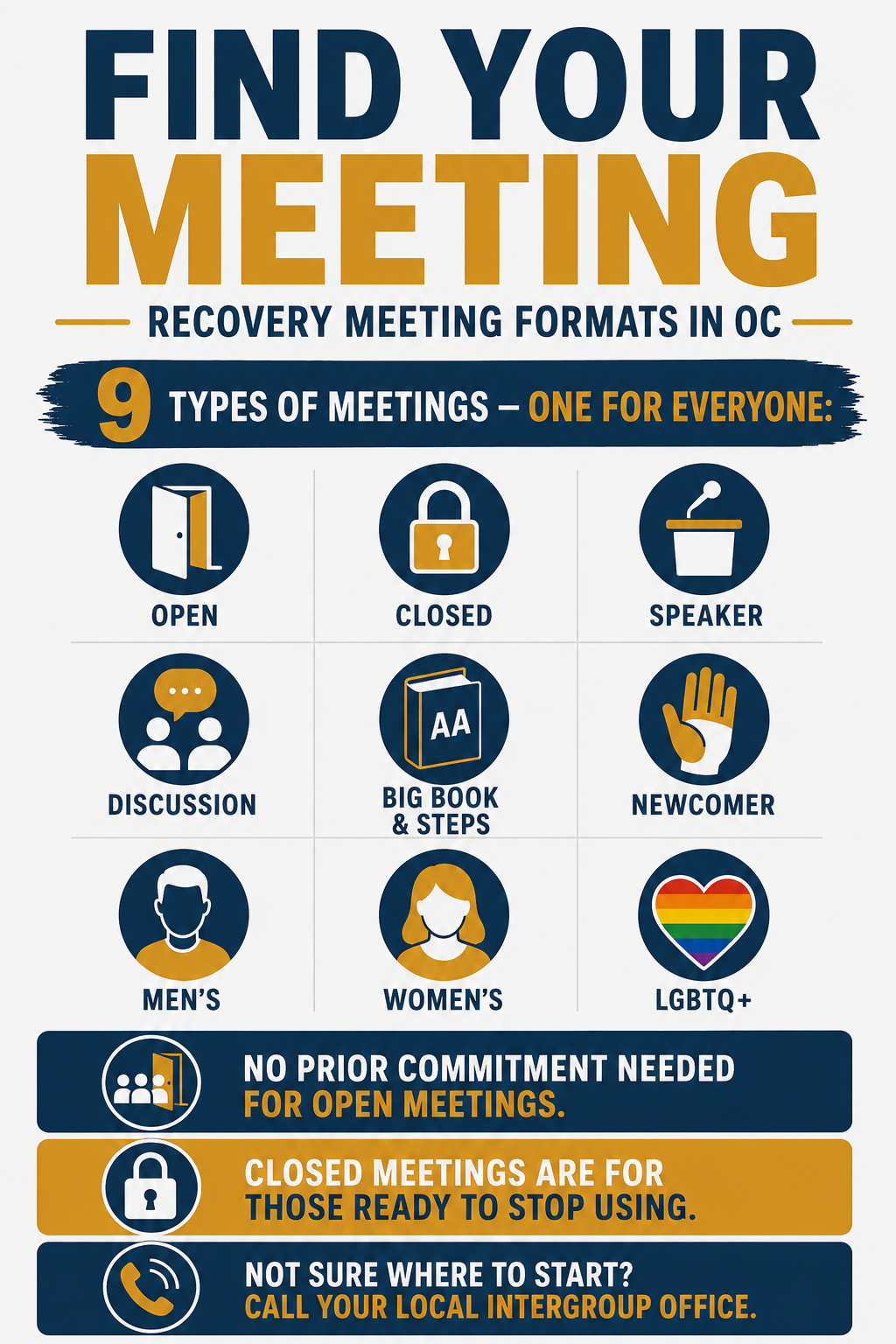
It can feel intimidating to walk into a recovery meeting for the first time, especially when you don’t know what to expect. These meetings can differ in format, and learning more about what’s out there can help you hone in on your best fit.
Meeting listings usually note the format along with the time and location. If you’re unsure what a particular meeting involves, call the local interoffice group or visit their website to get the details you need.
Common types of meeting formats include:
- Open meetings: Anyone can attend these gatherings, including family members, friends, or those who are curious about recovery. There’s no prior commitment required.
- Closed meetings: These meetings are limited to those who identify as having a desire to stop drinking or using substances, and tend to be more intimate and focused regarding their content.
- Speaker meetings: One or more members will share their personal stories of recovery, including things about what their active use was like, what happened, and how their healing has gone since then.
- Discussion meetings: Typically, a topic will be introduced for the group to explore.
- Big Book and step meetings: These meetings are usually structured around reading and talking about AA or NA literature, with a focus on doing stepwork throughout the program.
- Newcomer meetings: Designed specifically for people who are new or early in the recovery process, focusing on the basics and providing a welcoming atmosphere.
- Men’s and women’s meetings: Gender-specific gatherings that allow for candid conversation.
- Young people’s meetings: These are geared toward younger members navigating the recovery process and the pressures of early adulthood and identity.
- LGBTQ+ meetings: Safe, affirming spaces for LGBTQ+ people who want a recovery community that’s reflective of their experiences.
Finding Meetings by Area
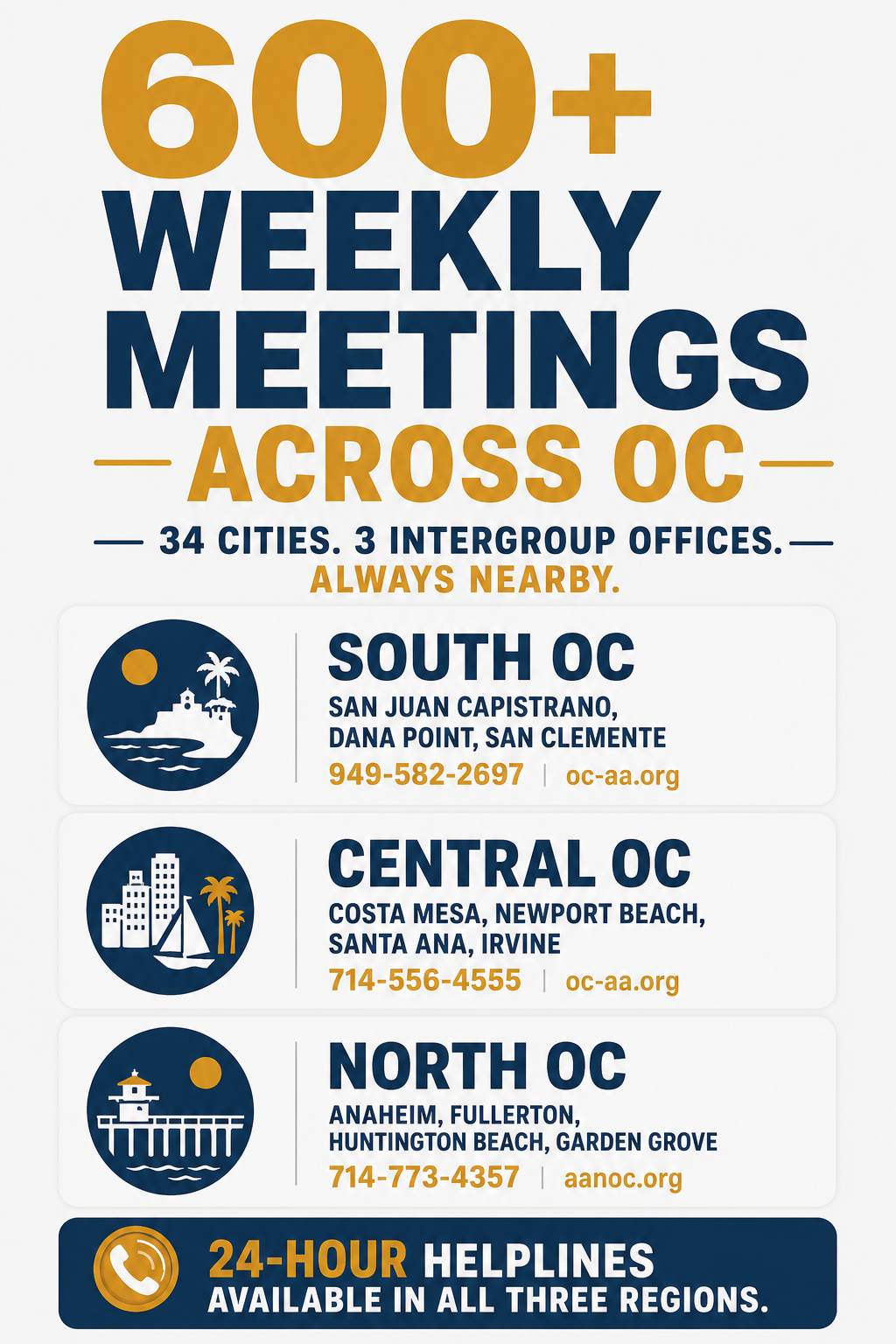
Orange County has more than 600 weekly AA meetings across 34 cities, served by three total intergroup offices with staffed, dedicated helplines. With many other organizations sporting a local presence, you’re sure to find a meeting within your reach nearly every day of the week.
Below, we discuss what certain regions within California have to offer.
South Orange County
San Juan Capistrano, Dana Point, San Clemente, Laguna, and more all have active recovery communities with plentiful meetings throughout the day. The beach-area meetings usually have a relaxed and informal atmosphere, being very welcoming to first-timers.
The San Clemente Friendship Center operates year-round as a dedicated AA space, and the San Juan Group in San Juan Capistrano offers both in-person and virtual meetings.
For meeting listings and schedules, contact the South OC Central Office at 30011 Ivy Glenn Dr., Suite 104, Laguna Niguel — 24-hour helpline: 949-582-2697. Full listings also available at oc-aa.org.
Central Orange County
The Costa Mesa and Newport Beach area is also home to a dense concentration of recovery meetings, with the Costa Mesa Alano Club hosting AA, NA, and Al-Anon meetings regularly.
The Attitude Adjustment group meets daily at 7 AM in Costa Mesa, and multiple meetings occur across Santa Ana, Irvine, Newport Beach, and Tustin regularly (and in several formats).
For meeting listings, contact the OC Central Office at 1526 Brookhollow Dr., Suite 75, Santa Ana — 24-hour helpline: 714-556-4555. A full directory is available at oc-aa.org.
North Orange County
Anaheim, Fullerton, Huntington Beach, and Garden Grove also host a diverse and active recovery community. For example, the Anaheim Alano Club is a well-established meeting hub, with many Spanish-language meeting options coordinated via the Oficina Intergrupal at 714-541-7225.
For meeting listings, contact the North OC Central Office in Fullerton — helpline: 714-773-4357, with a directory at aanoc.org.
What to Expect at Your First Meeting
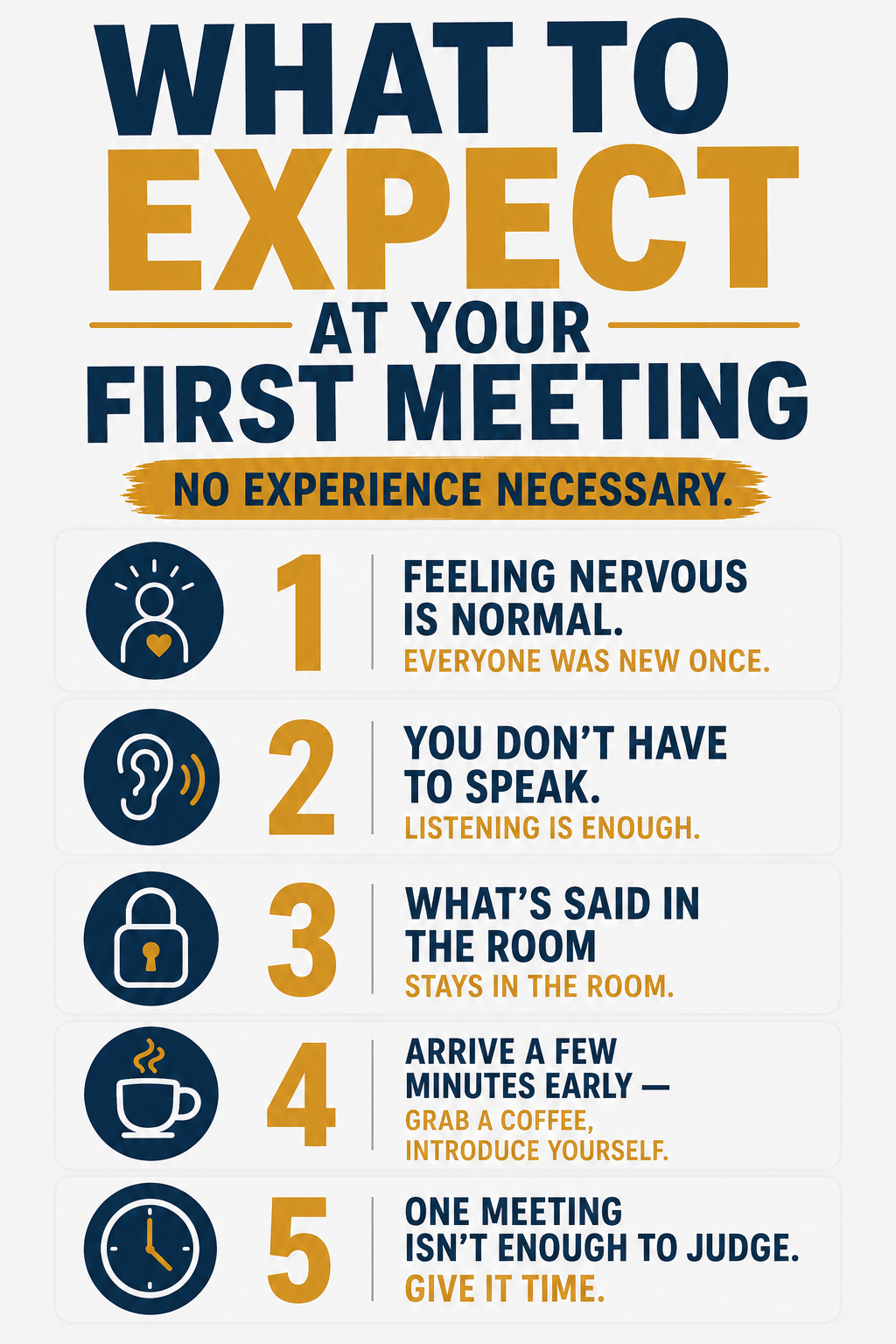
It takes true courage to start the recovery process, and walking into a meeting for the first time is no different. Feeling nervous is totally normal, and so is not knowing what to do when you arrive.
Most meetings start with a greeting, a few readings, and introductions. From there, the format depends on the type of meeting you’re at, but the atmosphere is almost always extremely welcoming.
You don’t have to say anything if you don’t want to. Listening to others is acceptable, especially at first, and no one should pressure you to share before you’re ready. If you do feel like speaking, you can share your name and whatever else feels right.
Remember that anonymity is usually a foundational principle of all meetings – what gets said in the room stays there, a concept that’s expected to be respected by everyone in attendance.3
Try to arrive a few minutes early, if you can, to grab a coffee and introduce yourself. Most seasoned members are glad to see someone new and will go out of their way to welcome you. After the meeting, you can also stay for a few minutes to start making new connections.
One meeting isn’t necessarily enough to know if a particular program will fit you. Each group has its own personality, so it’s recommended to focus on what you can relate to and give things time to develop, keeping your mind open to the possibilities.
Finding Your Home Group
A home group is just the name for a meeting you keep showing up to. It’s not something you choose after a first visit. A connection develops gradually over time, usually after trying out several different meetings and noticing when something clicks and feels natural.
It’s important to consider the practicalities, such as what time they meet and how close to you it is. But the most important question is whether or not you feel comfortable and connected. This is a combination that’s definitely worth traveling a little further or adjusting your schedule for as needed.
Getting involved can also open up new opportunities: greeting people at the door, making coffee, or helping set up and stacking the chairs after the meeting ends. Such small acts of service can make you feel like you belong and give you a role in the group, which tends to help strengthen your commitment as well.
Home groups are beneficial because they provide accountability. When a group knows you, they notice when you’re not there, which can be a powerful protective factor in the early days of recovery.
Online & Virtual Meetings
Virtual or online recovery meetings grew a lot during the pandemic and have maintained their presence, helping those who travel a lot or work irregular hours. They’re also helpful for those with limited local options or who just need to grab a meeting in the early hours of the morning during a craving.
AA’s online meeting directory at aa-intergroup.org lists thousands of virtual meetings running each day of the week, with NA maintaining its own dedicated virtual platform at virtual-na.org.
These meetings can also work very well as a supplement to in-person attendance, especially for filling gaps in your schedule or staying connected while traveling. In-person meetings typically still offer the best route to building local relationships for long-term recovery. However, a strong approach can involve both finding your home group and utilizing virtual meetings whenever life gets in the way.
Meeting Resources & Links
Finding the right meeting for you starts with knowing where to look. The resources listed below are reliable starting points for locating current and accurate meeting schedules across Orange County (and beyond).
Meeting times can and do change, so always try to verify directly with the relevant organization before you go for the first time.
-
-
- Orange County AA (OCAA): the primary directory for AA meetings across all of Orange County — searchable by city, day, and meeting type. Visit oc-aa.org or call the 24-hour helpline at 714-556-4555. North OC listings at aanoc.org, helpline 714-773-4357. South OC helpline 949-582-2697
- Orange County NA: full meeting directory for Narcotics Anonymous meetings throughout the county at orangecountyna.org. 24-hour helpline: 714-590-2388
- SMART Recovery: meeting finder for in-person and online SMART Recovery meetings at smartrecovery.org
- Al-Anon Orange County: meeting directory and resources for family members at al-anon.org
- Nar-Anon: support meetings for families affected by drug addiction at nar-anon.org
- Virtual AA meetings: worldwide online meeting directory at aa-intergroup.org
- Virtual NA meetings: online NA meetings around the clock at virtual-na.org
-
Frequently Asked Questions About AA and NA Meetings in Orange County
Are AA and NA Meetings Free?
They are: All 12-step meetings are designed to be free to attend. A basket might sometimes be passed for voluntary contributions to cover the cost of the room and program literature, but there’s no obligation to give.
Do I Need to Be Religious to Attend AA or NA?
No. While 12-step programs will often refer to a “higher power,” each member defines that concept for themselves. Many atheists or agnostics attend AA or NA, and there are also fully secular approaches (such as Refuge Recovery or Dharma Recovery) that offer a different approach.
How Can I Find Recovery Meetings Near Me?
Try the official AA meeting finder at aa.org and the NA equivalent at na.org. For Orange County specifically, oc-aa.org maintains a comprehensive local directory you can search by location, date, time, and meeting type. You can also call the OC AA Central Office helpline at 714-556-4555 to connect to a meeting.
Can I Go to AA if I Have a Drug-Related Issue?
You can – many people actually attend both AA and NA (along with other recovery-oriented activities), and most meetings are welcoming regardless of your drug of choice. The only formal requirement to attend AA is a desire to stop drinking, and by tradition, AA tends to focus on alcohol, but attendees can find connection and value in any recovery-focused space.
References
- Alcoholics Anonymous. (2024). History of A.A. | Alcoholics Anonymous. Www.aa.org. https://www.aa.org/aa-history
- SMART Recovery. (2024). Learn About SMART Recovery – SMART Recovery. Smartrecovery.org. https://smartrecovery.org/what-is-smart-recovery
- Alcoholics Anonymous. (n.d.). A.A. and Anonymity. Www.aa.org. https://www.aa.org/aa-and-anonymity
CONTACT NOW


info@abetterliferecovery.com

Address
30310 Rancho Viejo Rd.
San Juan Capistrano, CA, 92675
WE ARE FULLY LICENSED AND ACCREDITED