Fentanyl in Orange County
Fentanyl has been in the news a lot lately, changing the landscape of addiction and overdose in ways that would have seemed unimaginable twenty years ago. Fentanyl-related deaths in Orange County have risen over recent years, including many people who have no prior history of addiction or had no idea they were taking fentanyl at all.
The substance, which is odorless, tasteless, and lethal in extremely small doses, has been found in everything from counterfeit prescription pills to powders and other drugs. The crisis of fentanyl in Orange County, along with the rest of the nation, has made it painfully clear that no family is truly exempt from its impact.
Fortunately, high-quality and accessible treatments are available for opioid addiction and substance use. A Better Life Recovery is standing by to help you or your loved one start the recovery process.

What Is Fentanyl?
Fentanyl is a synthetic opioid, meaning it’s manufactured rather than derived directly from the poppy plant. The substance is anywhere from 50 to 100 times more potent than morphine and is used in legitimate medical settings to manage severe pain.1
The pharmaceutical version is highly regulated and delivered in careful doses under controlled settings. However, illicitly-manufactured fentanyl is primarily sourced from Mexico and China. It’s cheap to produce, profitable for traffickers, and so potent that the margin for error is nearly nonexistent. Additionally, fentanyl has flooded the illegal drug market at a speed that law enforcement and public health have found difficult to keep up with.
Fentanyl is extremely potent, so much so that two milligrams – around the equivalent of two grains of salt – can potentially be a lethal dose.1
With a clearer idea of what Fentanyl is, the next section explores why it seems to be in every substance.
Fentanyl Awareness: Why Fentanyl Is in Everything
Illicit fentanyl is often mixed into other substances. This is because it is cheap to produce and a small amount can produce an immense effect, meaning drug dealers can stretch and increase their profits.
Fentanyl regularly turns up in substances that have no connection to opioids and in forms that are designed to look otherwise legitimate. For example, counterfeit pills have become one of the most common delivery mechanisms of Fentanyl.
Recent reports tell us that fentanyl has been found in the following:2
-
- Counterfeit prescription pills, including fake versions of Oxycodone, Xanax, Adderall, and Percocet
- Heroin, with much of the supply being either heavily cut with or replaced by fentanyl
- Cocaine
- Methamphetamines
This is especially concerning when it comes to substances like cocaine and methamphetamines, because it puts people at risk who otherwise have no previous tolerance to opioids.
The saying “one pill can kill” is no exaggeration. We explore the effect fentanyl is having in Orange County next.
The Impact of Fentanyl in Orange County
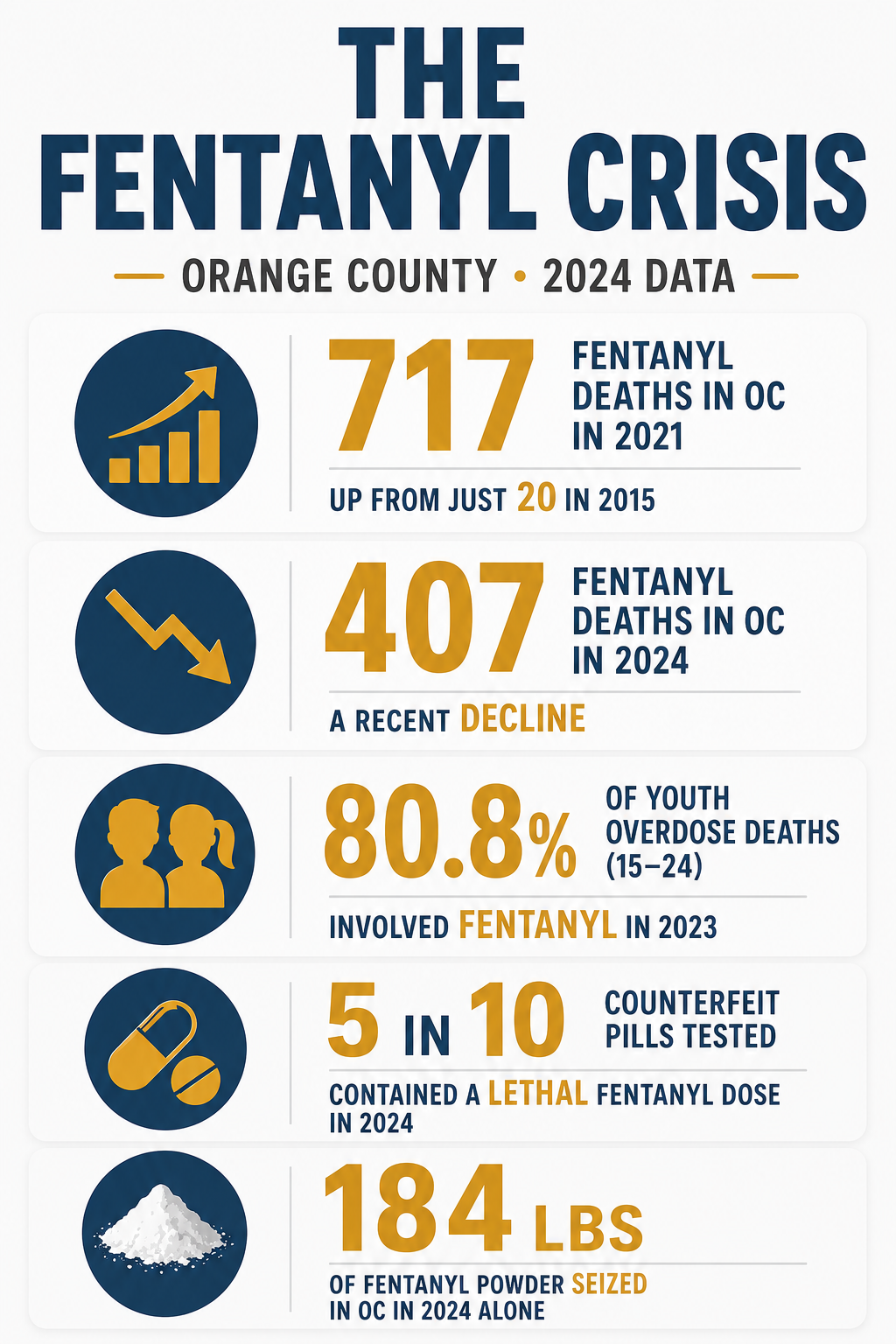
According to the Orange County Health Care Agency, the rate of fentanyl deaths orange county recorded rose from 20 in 2015 to 717 in 2021.1 However, more recent data shows only 407 fentanyl-related deaths in 2024.3
When it comes to adolescents and young people aged 15-to 24-year-olds, the number of deaths from fentanyl-related overdose rose from 2.7% in 2018 to 80.8% in 2023.4
What’s more, the Drug Enforcement Administration (DEA) reported that five out of ten counterfeit pills tested in 2024 contained a potentially deadly dose of fentanyl, compared to seven out of ten in 2023. On top of this, in 2024, in Orange County alone, narcotics teams seized more than 184 pounds of fentanyl powder and over 45,000 fentanyl pills.5
This shows that the fentanyl crisis is affecting communities across the nation that may never have thought of themselves as part of the drug crisis, and with devastating consequences.
While it may be difficult to tell whether someone is using illicit substances, the following section covers the warning signs to look for.
Warning Signs Your Loved One May Be Using
Experimenting with fentanyl can quickly turn lethal, so knowing what signs to look for matters. These signs may include:
-
- Finding pills from unknown sources: Any pills that didn’t come directly from a licensed pharmacy can be risky.
- Unexplained behavioral changes: Suddenly withdrawing from family and friends, an increased need for secrecy, unexplained mood swings, or sleeping at unusual times.
- Physical signs: Pinpoint pupils, drowsiness, slurred speech, or a general lack of coordination.
- Drug paraphernalia: Small baggies, tinfoil, burnt spoons, or pills that don’t match any prescriptions in your home.
- Unexplained money issues: Cash disappearing, valuables going missing, or requests for money without a clear or understandable reason.
Although the signs alone don’t confirm substance use, they may add up to something feeling “off” and deserve to be taken seriously. Overall, trust your instincts – parents and partners are often the first people to sense something is wrong.
Even if there are no obvious signs that your loved one is using fentanyl, it can be useful to know how to recognize an overdose, which we cover next.
Recognizing a Fentanyl Overdose
Unlike an overdose involving other substances, fentanyl acts rapidly, sometimes within seconds. This means the window for helping someone is small. However, fentanyl overdose signs are fairly easy to spot, and knowing them can be the difference between life and death.
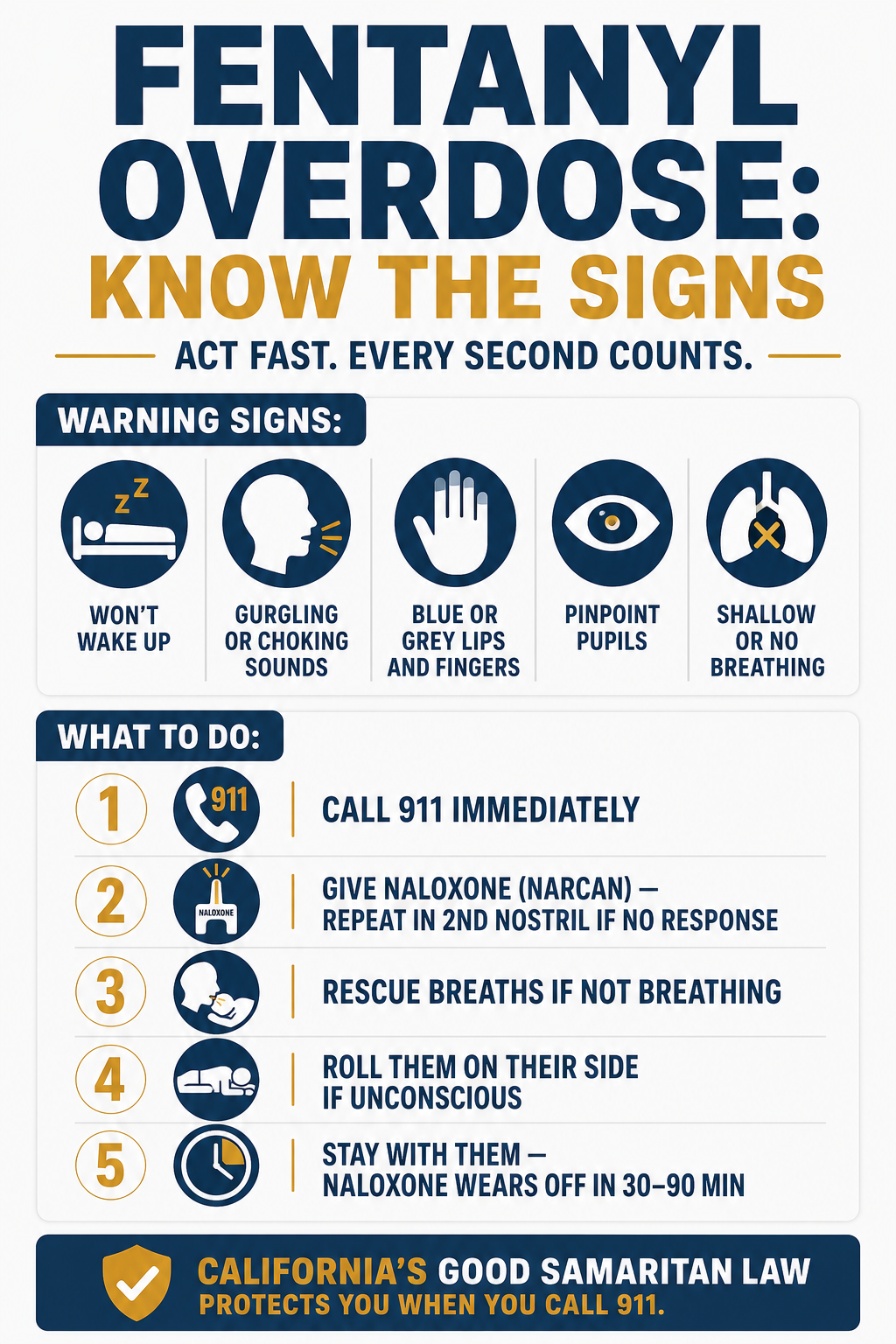
Breathing and drowsiness are some of the key signs of an overdose. For example, someone might appear to be asleep but can’t be woken, or they may make gurgling or choking sounds – known as a death rattle – as their airway becomes obstructed. Additionally, their breathing might become shallow or disappear entirely.
Physically, a person’s lips and fingers may turn blue or grey as their oxygen levels plummet. Their skin can become pale, while pupils may shrink to a pinpoint size, regardless of light. They also may not be responsive to your voice, being touched, or any attempts to move them.
If you notice these signs in your loved one, knowing what to do can make the difference between life and death. We cover the steps to follow in the event of an overdose in the next section.
What to Do if You Suspect Overdose
Every second matters in an overdose situation. The steps below are straightforward, and knowing them before you need to use them could help to save a life.
1. Call 911 Immediately
Call 911 before you try to do anything else, and tell the emergency dispatcher where you are. Emergency responders carry naloxone and can provide advanced care when they arrive.
California’s Good Samaritan law protects anyone who calls 911 during a drug-related emergency from prosecution of drug possession.
2. Administer Narcan (Naloxone)
If you have naloxone on hand, use it immediately, as it can reverse a possible overdose within minutes. The nasal spray is used by inserting the tip into one nostril and pressing down firmly on the plunger. If the person doesn’t respond within a few minutes, give them a second dose in the other nostril.
3. Give Rescue Breaths
If you’ve been trained in CPR and the person isn’t breathing, start rescue breaths while you wait for emergency services to arrive. Tilt their head back to open the airway, pinch their nose closed, and give one breath every five seconds.
4. Gently Place Them in the Recovery Position
If the person is still breathing but remains unconscious, roll them over onto their side to prevent choking if they throw up. However, do not move them if you suspect they may have a spinal injury (such as from a fall or high-impact accident), and instead wait for emergency responders to arrive.
5. Stay With Them
Naloxone wears off within 30 to 90 minutes, which means someone could slip back into an overdose after initially recovering. Additional doses might be needed, so try to keep the person talking and alert while you wait for the ambulance to arrive.
As Naloxone has been mentioned a few times, it may be useful to take a closer look at what it is and why it’s important to have it available. We explore this next.
Naloxone (Narcan): Keep It on Hand
Naloxone reverses an opioid-based overdose by blocking opioid receptors in the brain and restoring normal breathing, often within minutes. It’s available as a nasal spray (Narcan) or an injection and has no effect on someone who hasn’t taken opioids. This means it’s safe to use even if you’re unsure of the overdose substance.
It may be useful to know that Narcan doesn’t require a prescription in California and is stocked by many local pharmacies. No doctor’s visit is required, and keeping it on hand can be a lifesaver for a loved one or someone in the community.
You can also get Narcan from the Orange County Health Agency, which runs free distribution programs throughout the county, along with several community organizations and harm reduction programs. It can also be ordered online and shipped directly to your home.
Another way to support someone in recovery may be to have fentanyl test strips available, which we talk about in the next section.
Fentanyl Test Strips
Fentanyl test strips are small pieces of paper that were originally developed for urine drug testing. They can also detect the presence of fentanyl in a substance before it’s taken. The process involves putting a small amount of the substance into water, dipping the strip into it, and waiting a few minutes for the result to appear. Typically, a single line indicates that fentanyl is present, with two lines meaning it isn’t.
It’s important to know that while these test strips can be useful, they aren’t perfect. This is because fentanyl is often unevenly distributed in a batch of drugs, meaning one portion may test negative while another may contain a fatal dose. So, while a negative result is not a guarantee of safety, fentanyl testing strips do offer potentially valuable information that could save a life.
In California, fentanyl test strips are legal to both possess and distribute and are available through selected pharmacies, harm reduction programs, and online. In fact, the Orange County Health Care Agency has made distribution of fentanyl test strips in Orange County a priority as part of its ongoing fentanyl response strategy.
It’s worth highlighting that providing testing strips, naloxone, or other tools for harm reduction does not mean you are enabling substance use. Someone who survives an overdose has the chance to enter into addiction treatment and rebuild their life in recovery – whereas someone who dies from an overdose never has that chance. Harm reduction and treatment work hand in hand, with a growing body of research supporting this approach.6
While test strips and Narcan may be useful to keep in the home, it’s important to discuss safety around illicit substances with your loved ones, especially younger adults. We have some suggestions for how to talk to your children about fentanyl next.
Talking to Your Kids About Fentanyl
A generation ago, parents talking to their children about drugs tended to revolve around addiction and the potential long-term consequences. These days, experimental drug use can turn fatal quickly, and your children deserve to hear the message clearly.
These conversations often work best when the focus stays on the facts, with the message being direct. Having just one talk about fentanyl with your loved ones often isn’t enough. Instead, it helps to keep an open dialogue going, ideally before a situation comes up where your teenager has to make a quick decision without all the information they need.
Important things to touch on in the conversations include:
-
- No pill is safe: Any pill that didn’t come from a pharmacy could contain fentanyl.
- One-time use can kill: There is no safe experimentation when it comes to this powerful opioid, and tolerance is irrelevant because the first dose could be lethal.
- Fentanyl is in everything: Fentanyl has been found in cocaine, counterfeit pills, and many other substances.
- Social media can be dangerous: Drugs sold via Snapchat, Instagram, TikTok, and other online platforms are among the most common sources of fentanyl-laced pills that are killing young people today.
- They can always reach out to you: Make it clear that, if your child or one of their friends is in trouble, they can call you at any time for help.
Getting Treatment for Opioid or Fentanyl Addiction
The news about fentanyl and its consequences is scary, but fentanyl addiction is also inherently treatable. People recover from fentanyl and opioid addiction every day, including those who previously thought their situation was beyond help.
Fentanyl use can create a powerful dependency, which is why medical detox is the most appropriate starting point for many people. Attempting to go through the withdrawal process on your own without supervision can be extremely risky. However, a medically-managed detox keeps the process as safe as possible and addresses symptoms directly, creating a sustainable starting point for treatment to follow.
Medication-assisted treatment, or MAT, is one of the most significant tools available for opioid use disorder. Medications such as buprenorphine can reduce cravings, block the euphoric effects of opioids, and have been shown to improve long-term recovery outcomes.7
From there, effective treatment aims to address any potential complicating issues, such as co-occurring mental health conditions, underlying trauma, chronic stress, instability, or other factors that may be impacting addiction. That’s why a treatment program that includes a full spectrum of care and evidence-based treatment interventions can help you or your loved one heal.
A Better Life Recovery proudly provides fentanyl addiction treatment in Orange County, including MAT, individual and group therapy, and quality aftercare planning that’s built for long-term recovery. Same-day admission is available, so call us today to learn more about our opioid addiction treatment options and speak with someone who can help.
Frequently Asked Questions About Fentanyl in Orange County
Can You Overdose on Fentanyl Just by Touching It?
No, you can’t – this is a widely-circulated myth. Fentanyl isn’t absorbed well through the skin, and accidental contact is highly unlikely to cause an overdose. It’s still best practice to treat any unknown substance with caution and wash your hands after any contact.
How Do I Know if a Pill is Real or Fake?
For the most part, you can’t tell simply by looking at it because counterfeit pills can have the same shape, color, and markings as legitimate ones. So the only reliable way to tell is to make sure a medication comes directly from a licensed pharmacy.
Is Giving Someone Narcan Also Enabling Them to Use Drugs?
Narcan reverses an overdose, but doesn’t get you high or make drug use more appealing. Many people with years of recovery are alive thanks to being given Narcan during a potential overdose, and keeping someone alive gives them the chance to seek treatment and heal.
My Child Uses Marijuana and Alcohol. Should I Still Worry?
Neither marijuana nor alcohol typically contains fentanyl, but any substance use can evolve over time. The conversation about fentanyl is worth having with your children, regardless of their current usage patterns.
References
- National Institute on Drug Abuse. (2021, December 21). Fentanyl. National Institute on Drug Abuse. https://nida.nih.gov/research-topics/fentanyl
- DEA. (2023). One Pill Can Kill. https://www.dea.gov/onepill
- City News Service. (2025, November 13). Fentanyl-related deaths trending down in Orange County. KESQ. https://kesq.com/news/california/2025/11/13/fentanyl-related-deaths-trending-down-in-orange-county/
- National Center for Drug Abuse Statistics. (2025). Teenage Drug & Alcohol use: Statistics, Facts and Data. https://drugabusestatistics.org/teen-drug-use/
- Orange County Sheriff’s Department. (2025, November 13). Fentanyl-Related Deaths in Orange County See Five-Year Low. https://www.ochealthinfo.com/press/fentanyl-related-deaths-orange-county-see-five-year-low
- Pridgen, B. E., Bontemps, A. P., Lloyd, A. R., Wagner, W. P., Kay, E. S., Eaton, E. F., & Cropsey, K. L. (2025). U.S. substance use harm reduction efforts: a review of the current state of policy, policy barriers, and recommendations. Harm Reduction Journal, 22(1). https://doi.org/10.1186/s12954-025-01238-4
- McKay, C. D. (2017). Medication Assisted Treatment for Opioid Use Disorder. Delaware Journal of Public Health, 3(4), 46–49. https://doi.org/10.32481/djph.2017.08.011
CONTACT NOW


info@abetterliferecovery.com

Address
30310 Rancho Viejo Rd.
San Juan Capistrano, CA, 92675
WE ARE FULLY LICENSED AND ACCREDITED